Shared hosting is the market of "unlimited": unlimited bandwidth, unlimited storage, unlimited domains. Everyone says the same thing, nobody says what machine is underneath, and the buyer ends up choosing on price because there is nothing else to compare. Super Awesome Host wanted to compete the other way around.
 superawesomehost.com Live
 Decide what you sell first, then how you tell it
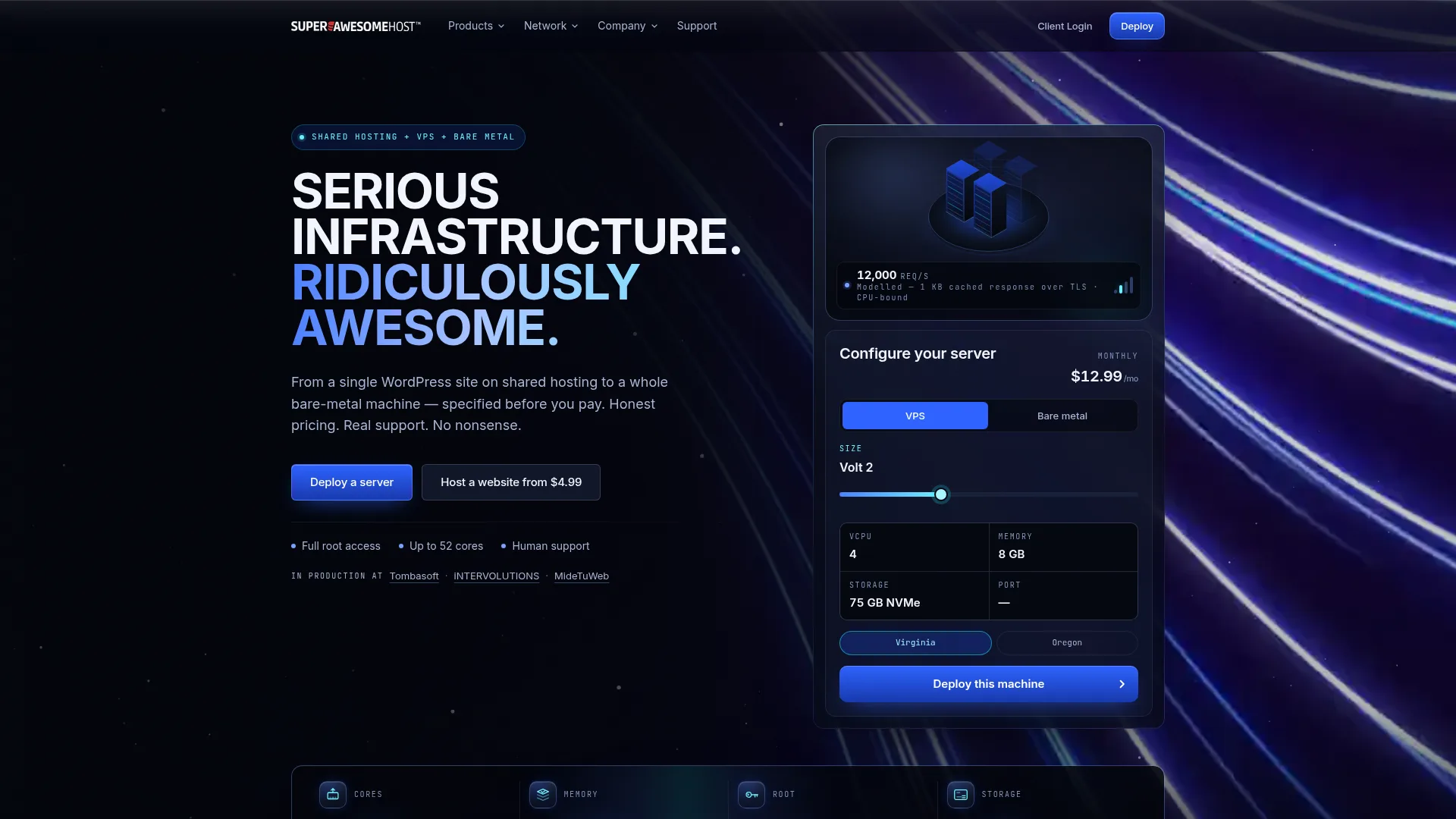
The catalog was organized into three layers that answer a single question: how much machine do you want? Shared hosting with a domain included, NVMe VPS, and dedicated bare metal. These are not three tiers of the same thing — they are three different answers, and the store says so in those words instead of with little stars.
The spec sheet as the sales argument
Every plan publishes what you actually get: cores, memory, disk type and region. That sounds obvious until you look at the competition. Publishing the exact spec has a side effect we did not expect: it cuts pre-sales tickets, because the question people were about to ask is already answered on the page.
If you have to hide the spec to sell the plan, the website is not your problem.
WHMCS behind, storefront in front
Sign-ups, billing and tickets ran on WHMCS, which the client already used and which worked. What we rebuilt was everything in front of it: the storefront, the plan comparison and the path to checkout. Integrating instead of replacing left the system that bills untouched — the one nobody wants to touch on a Friday.
September 2026 update: that layer is no longer WHMCS. We have just migrated it to Paymenter, with the customer and subscription history intact. The front — the storefront this piece is about — was not touched, which was the whole point of having separated them.
Personality without spending the credibility
The brand is cheeky — "Serious infrastructure. Ridiculously awesome." — and that was the risk: that the tone would eat the trust. The rule we set was that the humor could live in the headlines and never in the data. A spec table does not make jokes.
“Unlimited” is a ranking problem, not only an honesty problem
When an entire industry writes the same word, that word stops being useful for finding you. Nobody searches “unlimited hosting” with intent to buy: they search “NVMe hosting”, “4 vCPU VPS”, “hosting with Plesk included”, “European server with daily backups”. All of those are specific, and all of them answer themselves if the plan publishes its specification.
It is the difference between a page made of adjectives and a page made of nouns. Only the second one can be indexed for anything.
The comparison table is the page that converts
In a hosting shop, the decision is not made on a plan's own page: it is made by comparing. So the comparison is not an extra at the bottom, it is the centrepiece, and it has three rules.
- The same rows for every plan, including the ones a plan does not meet. An empty cell informs; a row that disappears looks like something is being hidden.
- No ambiguous ticks where a number belongs. “Backups ✓” says nothing; “daily backups, 7 retained” does.
- The renewal price next to the sign-up price. It is the number the industry hides best, and the one that causes the most anger when it shows up a year later.
Every missing figure in the table comes back as a pre-sales question. Publishing the full specification is not decorative transparency: it is work you do not have to do later.
Storefront and billing are two systems, and that shows up years later
The storefront was rebuilt entirely; the system that charges was left alone. That separation looked like a scheduling decision and turned out to be what saved this year's billing-platform migration: the engine behind it changed and the public side stayed put, with its URLs, its rankings and its content intact.
Had the storefront been billing-system templates — which is how most hosting shops are built — migrating would have meant rebuilding the site too, losing the URLs and starting over in search.
Promising uptime is a contract, not a headline
Putting an availability figure on the front page is easy; standing behind it is another matter. A figure with no definition of what counts as downtime, what window it is measured over and what happens when it is missed, is decoration. With a definition and a remedy attached, it is a commercial commitment — and then it really does set you apart from whoever just writes it in a big font.
The rule we proposed to the client is the same one we apply to our own care plans: do not publish a number you cannot measure and show.
What this means for anyone selling something comparable
In a market where the product is nearly identical and the price nearly the same, the only thing left to compete on is the quality of the information. Publishing more than the competition publishes is, literally, the strategy. It works in hosting exactly as it works in any service where the buyer does not know what they are comparing.