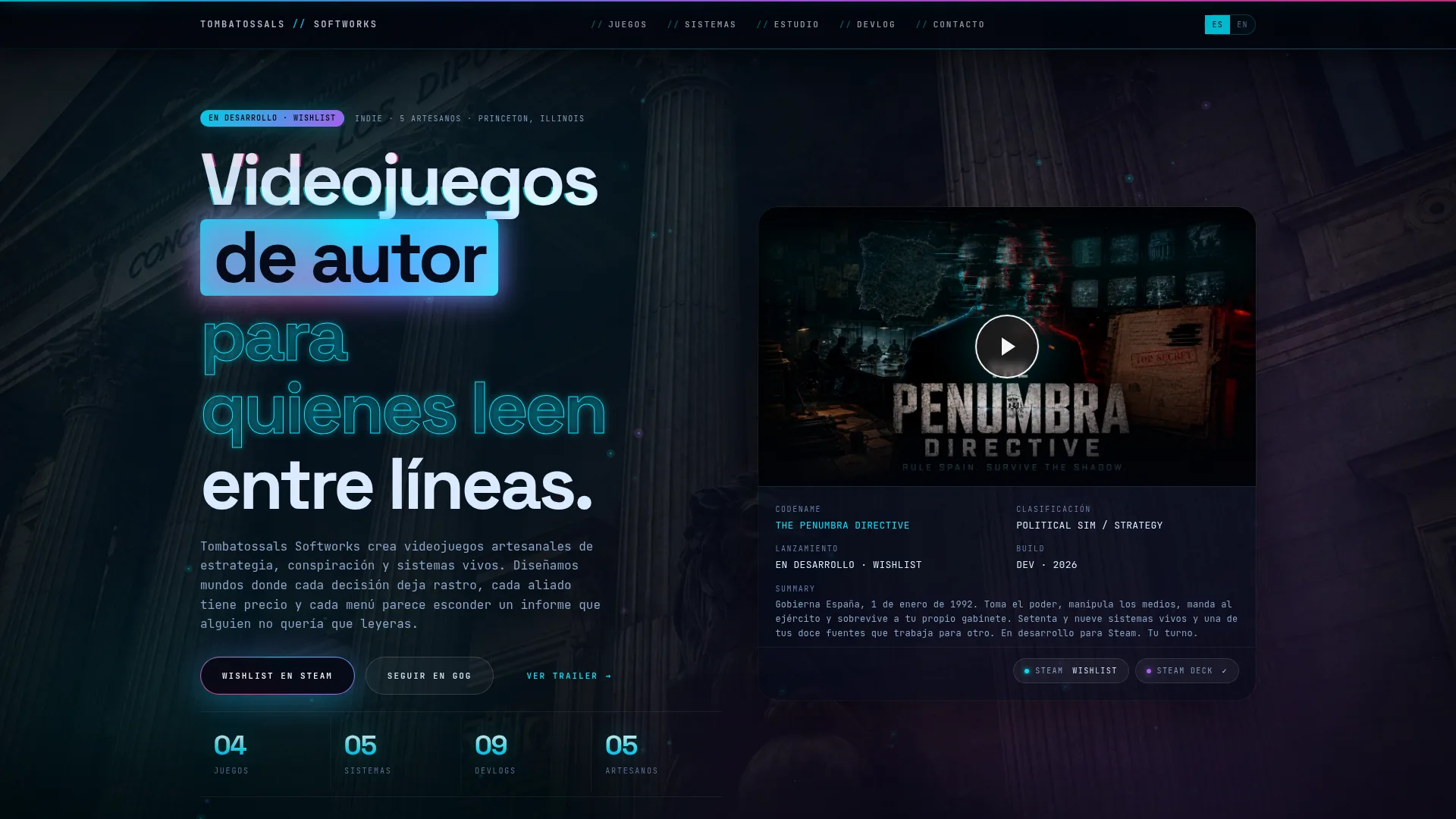
Tombatossals Softworks are five craftspeople with no managers and no hierarchy, based in Princeton, Illinois, and their first title is a political strategy thriller set in 1992 Spain. Their site could not be a company brochure. It had to sound like the game.
 tombasoft.com Live
 The default mistake: explaining the company
Almost every small studio site opens the same way: “We are an independent studio founded in…”. Nobody who is not an investor cares. A player arriving from a video or a forum wants to know in thirty seconds what the game is, what it feels like to play, and when they can play it.
So the site does not talk about the company until it has talked about the game. The first screen is tone: the world of The Penumbra Directive, Spain in 1992, the feeling of reading between the lines. The studio comes afterwards, and it comes as five named people rather than a brand.
The typography is half the game
A dense political thriller asks for a dense graphic voice: typefaces with character, long measures, a lot of black. It is exactly the opposite of what a corporate site would ask for, and that is why it works: you recognise the genre before you have read a sentence.
The risk in that decision is legibility, and it gets paid back where you cannot see it: contrast measured against the real background rather than a theoretical grey; a generous body size; and a clear line between where the atmosphere ends and where the text has to be effortless. Atmosphere lives in the headings and the interstitials; the long paragraphs read like they would on any well-made site.
No CMS, for a specific reason
The content is versioned in the repository and the deploy is static. No admin panel, no database, no security updates to apply on a Sunday.
That is not technical purism. A five-person studio has nobody on the website full time, and an unmaintained WordPress is a breach waiting its turn. With no CMS, the site's attack surface is essentially that of a file server, and publishing a news item is the same gesture they already make every day with the game's code.
If the person publishing does not touch a repository, a static site with no admin is a trap: they end up depending on us to change a date. It works here because all five are developers.
Five team profiles, and why they are not decoration
Everyone in the studio has a profile: what they do, what they did before, how to find them. In an indie studio that is the entire body of social proof — there are no client logos or awards to show — and it is also what a search engine reads as real entities behind a project.
Showing specific people has an effect we had not fully anticipated: the specialist press cites names, not studios. When the name and the role live on their own linkable page, the citation arrives with a link.
A game site is measured by something else
There is no cart here and no quote form. The goals are different: watch the trailer, wishlist it, follow the studio. The whole structure pushes towards those three places, and there is no fourth competing with them.
It is the same discipline we apply to a services site, with different exits: decide which action matters and put nothing beside it that dilutes it.
What a small studio takes away
An indie studio competes for attention with catalogues of thousands of titles. It will not win that fight by explaining its mission and values. It wins if the site conveys the exact tone of what it made on the first scroll, and if behind it there are five people with faces and names instead of a contact form.