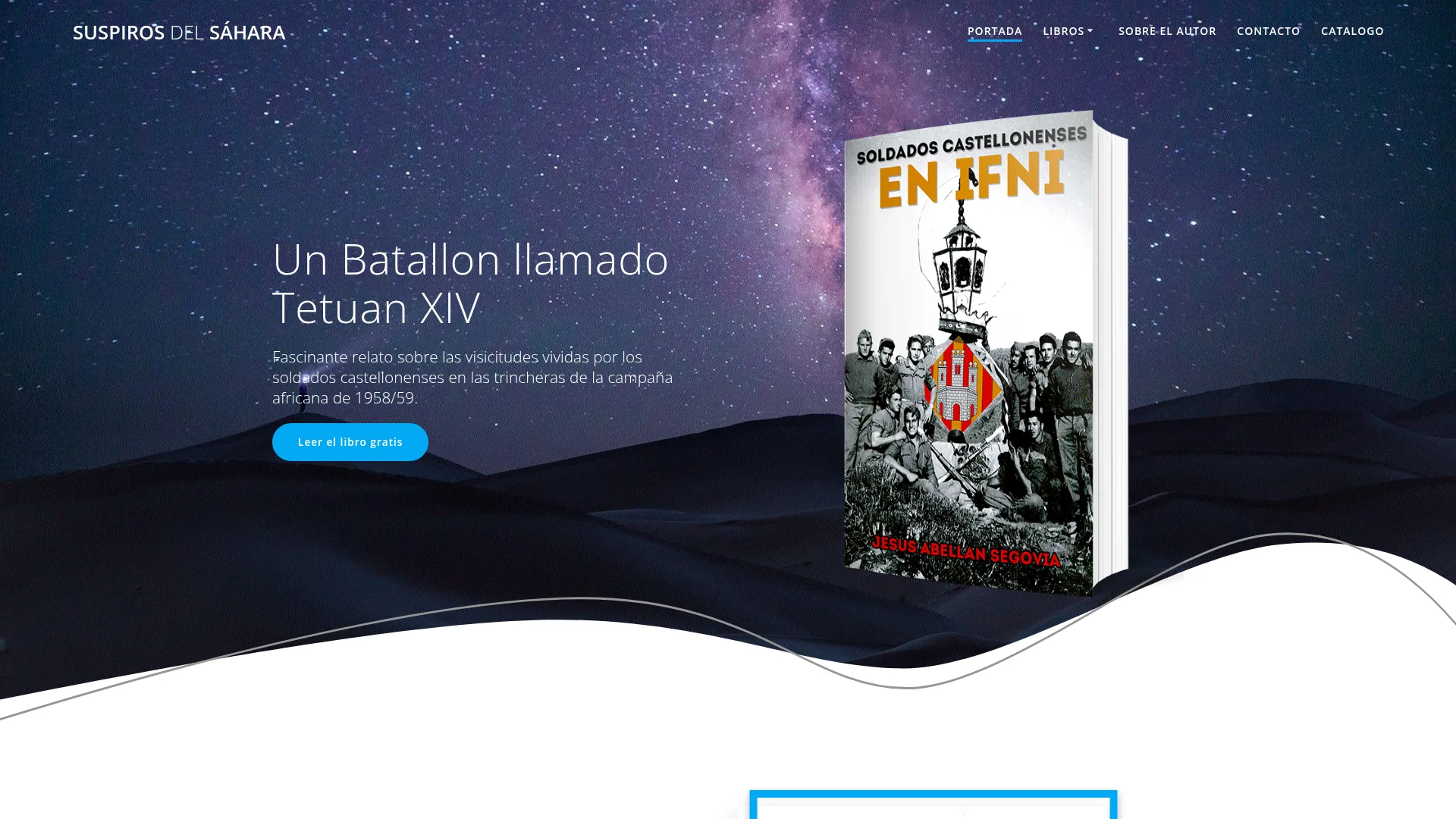
Suspiros del Sáhara publishes three books about the Ifni War (1957-1958) and a Castellón soldier's diary, all free to read. It is not a blog with long posts: it is a body of work that has to be readable end to end, on a screen, without wearing the reader out.
 suspirosdelsahara.com Live
 Line length rules everything else
A twenty-thousand-word text gets abandoned because of its layout long before it gets abandoned because of its content. And of every setting, the one that matters most is measure: how many characters fit on a line. Too wide and the eye loses its place coming back to the left margin; too narrow and the rhythm breaks every three words.
The band that works sits between 60 and 75 characters per line. You set it with a maximum width in units relative to the type, not in pixels, so it still holds when a reader enlarges the text — which on a site consulted by veterans' families, by readers in their seventies and eighties, is not an edge case but the norm.
Size, leading and hierarchy: three numbers that travel together
- Body text above the equivalent of 18 pixels. For long-form reading, 16 falls short as soon as the screen moves away from the eyes.
- Leading of 1.6 to 1.7 in the body, tighter in headings: a headline with the same leading as a paragraph looks like it is floating loose.
- Space between paragraphs greater than the leading. If they match, the text becomes a wall and the reader cannot find their way back when they look up.
None of this is personal taste. It is what decides whether someone reads the whole chapter or closes the tab after two minutes.
Episodes, not endless chapters
The three books are split into episodes. The reason is editorial before it is technical: an episode is one sitting, it has a beginning and an end, and you can come back to it without rereading. But the technical consequence matters just as much: each episode is its own URL, with its own title and description, and can surface in a search on its own.
A whole book on one long page is a single URL competing for twenty different topics, and it wins none of them. Split into episodes, each one answers what somebody is actually searching for: a name, a date, a specific place in the campaign.
The photo archive is heavy, and it shows
Archive photographs arrive scanned, large, and in formats that were never meant for the web. Serving them untouched turns a reading page into a multi-megabyte download.
The treatment is always the same: several sizes generated from each original, srcset so the browser picks the one that fits its screen, a modern format with a fallback, and lazy loading on everything below the fold. The header photograph is never lazy: it is the large element on the page, and deferring it means making the metric that measures its load worse.
The full original is kept and can be opened at full size. Someone looking for their father's face in a photograph from 1958 wants to zoom in, and that is exactly the person the site exists for.
Every photograph carries a caption with whatever is known about it: place, approximate date, who appears if it is on record. That is what turns it into a document rather than an illustration, and what makes it findable by searching a name.
A transcribed diary is its own problem
Pascual Guillamón's diary is transcribed. A transcription is not laid out like a chapter: it keeps each entry's date as a heading, respects breaks and marginal notes, and distinguishes typographically between what the author wrote and what an editor added for clarity. If that distinction is not visible, the document stops being trustworthy.
Why this is engineering, not decoration
It is easy to write a site like this off as “a WordPress with some text in it”. But the actual brief was that a lifetime's work should be readable, searchable and preservable. Those are structural decisions — episodes as URLs, a visibly distinct transcription, images with context — taken once and lasting as long as the site does.
They have treated the memory of those soldiers with exquisite respect. Seeing the diary and the photographs presented this way, within anyone's reach, is more than I imagined when I began to write.
J.A. Segovia, author of Suspiros del Sáhara